
Improving your church website search engine optimization (SEO) does not require technical expertise or hours of free time. A few simple updates can help your church show up in the moments when people are searching for hope, direction, or a church family. These steps help strengthen your online ministry presence so more people in your local community can find your church. With the right focus, SEO becomes one more way to support discipleship—not a burden on your week.
Why Your Church Website Needs Strong SEO
Your church website is often the first place a searching family, a new believer, or a neighbor in crisis will look for answers. When your website doesn’t appear in search results, your church’s ability to expand its reach is limited—and opportunities to live out the Great Commission and reach the lost can quietly slip by.
Many church leaders already feel stretched thin balancing sermons, counseling, outreach, and family life. Adding “learn SEO” to that list can feel unrealistic. The good news is that search engine optimization (SEO) is not about mastering complicated tools. It’s about helping more people discover the ministry God has already entrusted to your church.
You don’t need technical skill or hours of time to strengthen visibility. Simple updates—like clearer titles, faster load times, or fresher content—can help improve church website ranking in ways that impact real people looking for a church home.
These small adjustments remove barriers so your community can find service times, sermons, and next steps. When search visibility improves, you widen the front door of your ministry.
This post will walk you through practical, pastor-friendly ways to improve search visibility in 2026 without adding stress to your week.
1. Update Your Church Website SEO Page Titles
Clear, accurate SEO titles help searchers understand what your pages offer. When page titles are vague or outdated, search engines struggle to match your content with what people are looking for.
Start with your homepage, ministries, sermons, and events. Write titles in everyday language—terms your guests would naturally use. This is one of the easiest SEO tweaks your church can make.
Consider using:
- Homepage: “[City] Church | Worship, Ministries, and Community”
- Sermons: “Biblical Sermons from [Church Name]”
- Ministries: “Youth Ministry in [City] | [Church Name]”
- Events: “Upcoming Events at [Church Name]”
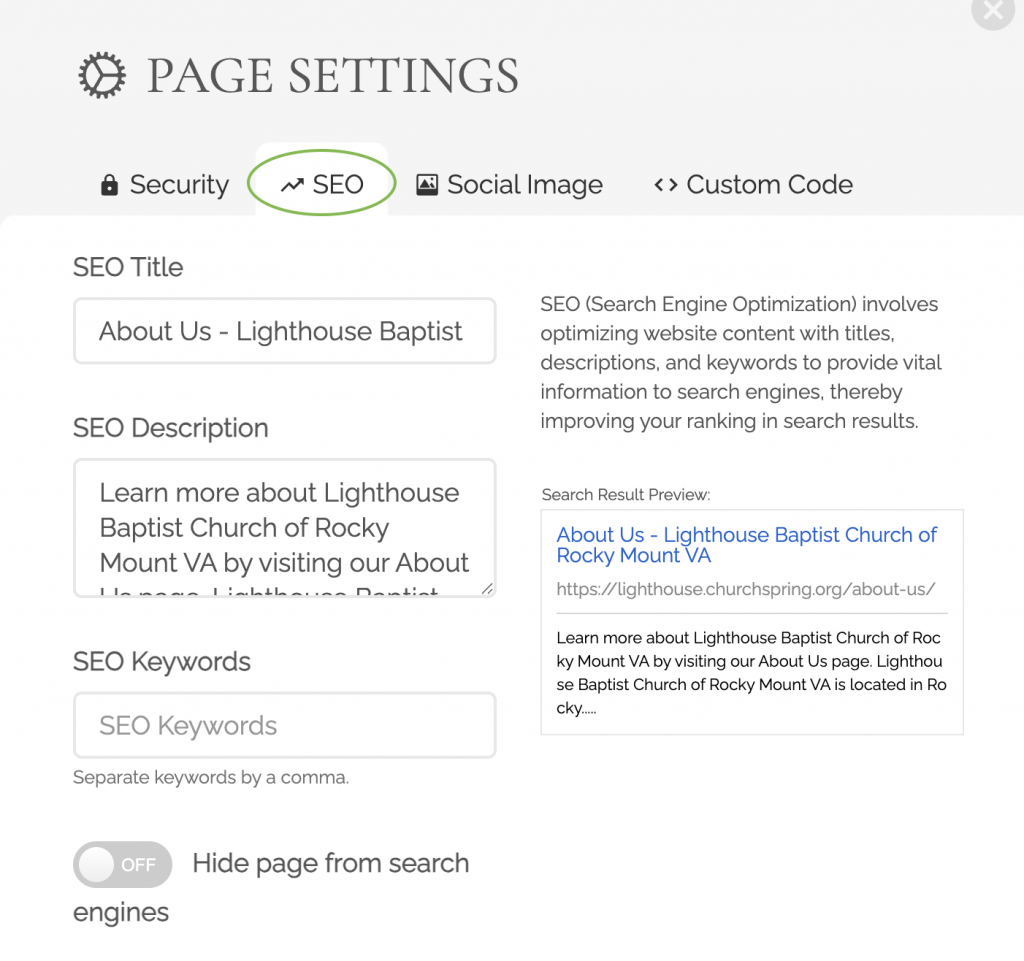
These small adjustments create clarity for both people and search engines. When your pages speak the language your community uses, they become easier to find.
Optimizing page titles is one area where the top features for church website builder tools really shine, because they help you edit these details with confidence.
With ChurchSpring’s Church Website Builder, built intentionally for small and mid-sized churches, you can update your page titles in seconds. Everything is organized in one simple dashboard, making it easy for pastors and volunteers to keep pages accurate without touching code.
“Love this website. So easy to use. Since using ChurchSpring, our website has had many more visits. Highly recommend it!”
Tammy D., Country Cowboy Church
2. Add Descriptive Alt Text to Your Images
Alt text is the short description behind every image on your website. Search engines rely on it to understand what your images represent, and screen readers use it to help visually impaired visitors.
When churches skip alt text or write unclear descriptions, they avoid a major SEO mistake
Write alt text that clearly describes:
- Who or what is in the photo
- The event or ministry shown
- The purpose of the image
- What detail matters most
Examples:
- “Pastor preaching Sunday morning message”
- “Children’s ministry volunteers preparing crafts”
- “Easter service guest welcome table”
Meaningful descriptions strengthen both accessibility and search visibility. It’s one of the simplest ways to serve your community and improve SEO at the same time.
3. Create Fresh Content That Serves Your Community
Search engines value websites that offer helpful, consistent content. Creating posts that answer questions your people are already asking is one of the best SEO tactics for your church website.
You don’t need long articles or formal devotionals—just content that supports your ministry.
Helpful content ideas:
- Weekly sermon highlights
- Ministry updates
- Event recaps
- Local outreach opportunities
- Discipleship resources
- Guest-focused FAQs
- Seasonal encouragement posts
Fresh content signals that your church is active and caring for people. It also gives Google more opportunities to match your pages with local searches.
When you write consistently, you naturally build a library of church digital communication assets that support your mission.
ChurchSpring’s Church Website Builder includes simple posting tools designed for pastors, volunteers, and anyone who needs to publish updates quickly on your blog, sermons, or events page. You can write, format, and publish updates quickly — and even pair them with ready-to-go social media posts for easy sharing.
“This is a great website for those like myself who are not very techy, but can also update little things at any time quickly and easily.”
Ted Kiger, Trinity Worship Center
4. Strengthen Your Internal Linking
Internal links help visitors and search engines navigate your website. When one page connects naturally to another, your content becomes easier to understand and easier to rank.
This is an often‑missed step on many church websites, but it’s one of the most practical ways to improve church website ranking.
Add internal links when:
- Mentioning ministries
- Highlighting upcoming events
- Sharing sermon references
- Announcing sign-ups
- Inviting people to next steps
Internal linking helps guide curious guests, support discipleship pathways, and strengthen the structure of your website.
A thoughtful internal link often says, “Here’s your next step,” which is the heart of ministry.
5. Improve Website Speed and Performance
A slow website can prevent families from finding important information. Most visitors will leave a page within seconds if it loads too slowly, which impacts your church website’s SEO and overall user experience.
Speed improvements do not need to be technical. Start with the most approachable updates.
Simple ways to improve speed:
- Compress images before uploading
- Limit oversized homepage slideshows
- Remove outdated files
- Use optimized video hosting platforms
- Choose clean, modern templates
Fast-loading pages help visitors find what they need without frustration. A smooth experience communicates care and hospitality long before someone arrives on Sunday.
6. Review Your Most Important Pages
As you plan for the new year, review your most visited pages. This is where a church website builder checklist becomes especially helpful.
Focus on the pages guests visit most:
- Homepage
- Sermons
- Ministries
- Events
- About
- Plan a Visit
Check each page for clarity, accuracy, and next steps. Small edits can have a meaningful impact on both user experience and SEO.
When these pages reflect your mission clearly, they help strengthen both outreach and discipleship.
Simple SEO Steps That Strengthen Your Ministry
Your church’s digital front door matters more today than ever. When people in your community search for hope, direction, or a church family, you want them to find a clear, welcoming message that reflects who you are and the mission God has entrusted to you. These SEO steps are small, but they open meaningful pathways for real people to connect with your ministry.
Improving church website SEO isn’t about chasing trends or mastering complex tools. It’s about removing barriers so the Gospel can be found more easily. Every title you clarify, every image you describe, every piece of content you share becomes another way to reach, teach, and serve your neighbors.
The work you do online matters because the people you’re trying to reach matter. A stronger digital presence is simply another expression of faithful stewardship—inviting guests, supporting discipleship, and helping families discover your church long before they walk through your doors.
Explore how ChurchSpring’s church website builder can help your church communicate clearly, stay organized, and share the Gospel online with confidence. Try ChurchSpring free for 7 days or join a live demo to see how simple it is to update your website.
FAQs
1. What is church website SEO and why does it matter?
Church website search engine optimization (SEO) helps people discover your ministry when they search online. It increases visibility so guests, families, and neighbors can easily find your service times, sermons, and next steps.
2. How often should churches update their content for SEO?
Consistent updates are helpful, but at least once or twice a month is enough for most churches. Fresh content shows that your ministry is active and caring for people.
3. Do I need technical experience to improve SEO for churches?
No. Most improvements are simple steps such as updating titles, adding alt text, and strengthening internal links. A church website builder can make these tasks even easier.
4. What pages should churches optimize first?
Prioritize your homepage, Plan a Visit page, ministries, events, and sermons. These pages serve guests directly and greatly influence how people experience your church online.
5. How does ChurchSpring help improve SEO?
ChurchSpring includes built-in SEO settings, fast-loading templates, and tools that simplify updates. It supports your ministry by making technical tasks feel accessible and manageable.